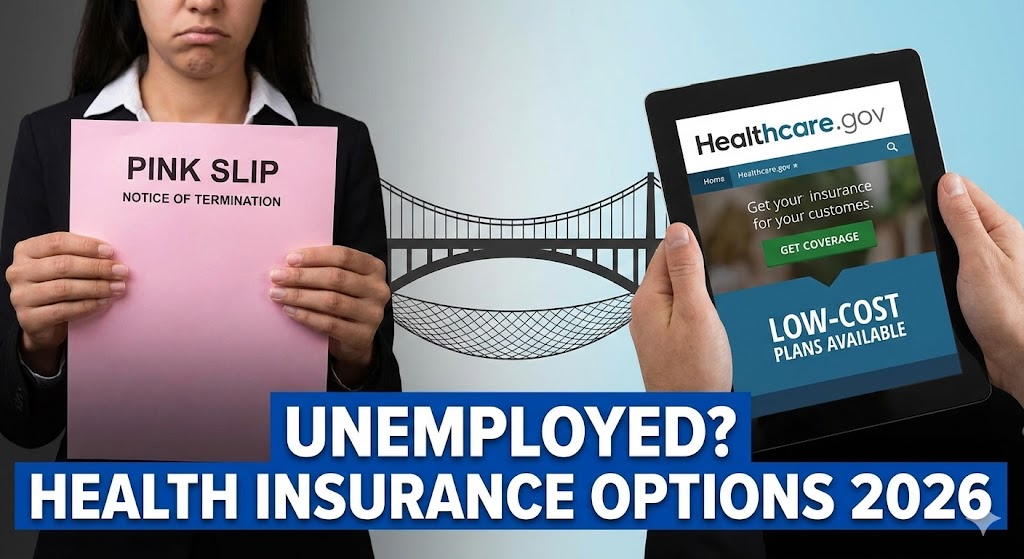
Losing a job is one of life’s most stressful events. Amid the scramble to update resumes and file for unemployment benefits, there is a looming question that keeps many Americans awake at night: “What do I do about my health insurance?”
In the United States, healthcare is inextricably linked to employment. When the paycheck stops, the coverage often stops with it. But here is the good news: You have more options than you think.
Whether you were laid off, fired, or quit, you are not without a safety net. From government-subsidized Marketplace plans to temporary gap coverage, the 2026 landscape for health insurance for unemployed adults offers several viable paths to stay protected.
This guide will break down the best health insurance plans for the unemployed, explain how to maximize your savings, and help you avoid the financial disaster of being uninsured.
1. The “Qualifying Life Event”: Your Golden Ticket
First, you need to understand the mechanism that allows you to get insurance outside of the standard “Open Enrollment” window.
Losing your job-based health coverage is considered a Qualifying Life Event (QLE). This triggers a Special Enrollment Period (SEP), which typically lasts 60 days from the date your coverage ends.
During this 60-day window, you can buy a plan on the ACA Marketplace (Healthcare.gov) or switch to a different insurance type. If you miss this window, you might be locked out of coverage until the next year, so acting fast is critical.
2. The Affordable Care Act (ACA) Marketplace: The Best Option for Most
For the vast majority of unemployed Americans, the ACA Marketplace (often called Obamacare) is the most affordable and comprehensive solution.
Why It Wins
- Subsidies: The government provides Premium Tax Credits to lower your monthly bill. In 2026, enhanced subsidies are still in effect, meaning many unemployed individuals can find plans for $10 or less per month.
- Comprehensive Coverage: All Marketplace plans must cover “Essential Health Benefits,” including prescriptions, emergency services, and mental health.
- Pre-existing Conditions: You cannot be denied coverage or charged more because of your health history.
The “Income Estimation” Trick
When you apply on Healthcare.gov, you will be asked to estimate your household income for the entire year of 2026, not just your current monthly income.
- Include: Unemployment benefits, severance pay, spouse’s income, and any money earned before you lost your job.
- Why it matters: If your estimated annual income falls between 100% and 400% of the Federal Poverty Level (FPL), you qualify for massive savings.
Pro Tip: If you project your income will be very low (but above the poverty line), look for Silver Plans. These are the only plans that offer Cost-Sharing Reductions (CSRs), which lower your deductible and copays, making medical care almost free at the point of service.
3. Medicaid: The $0 Cost Solution
If your income has dropped to zero or near-zero, you may not need to pay for insurance at all. Medicaid is a state and federal program that provides free or low-cost health coverage to millions of Americans.
Eligibility in 2026
Medicaid eligibility depends largely on where you live.
- Expansion States: In most states (like New York, California, and Illinois), you qualify if your current monthly income is below 138% of the Federal Poverty Level (approx. $1,732/month for an individual in 2026).
- Non-Expansion States: In states that did not expand Medicaid (like Texas or Florida), qualifying as a childless adult is extremely difficult, even with zero income.
Immediate Coverage
Unlike private insurance, Medicaid enrollment is open year-round. If you qualify, coverage can sometimes be retroactive up to three months, covering medical bills you’ve already incurred.
4. COBRA: Keeping Your Old Plan (At a Premium)
The Consolidated Omnibus Budget Reconciliation Act (COBRA) allows you to keep the exact same insurance plan you had with your employer for up to 18 months.
The Sticker Shock
While keeping your old doctors and network sounds great, COBRA is famously expensive.
- The Cost: You must pay the entire premium yourself (both your share and what your employer used to pay) plus a 2% administrative fee.
- The Math: If you used to pay $150/month, but your employer paid $450, your COBRA bill will be roughly $612/month.
When Does COBRA Make Sense?
- You have already met your deductible for the year.
- You are in the middle of a complex medical treatment (like chemotherapy or pregnancy) and cannot risk switching networks.
- You only need coverage for 1-2 months before starting a new job.
5. Short-Term Health Insurance: The “Gap” Fix
If you missed your enrollment window or simply need the absolute cheapest coverage for a few months, short-term health insurance is an option.
The Pros
- Speed: You can get approved and covered as soon as tomorrow.
- Price: Premiums are often significantly lower than unsubsidized ACA plans.
The Cons (Read Carefully!)
These plans are not ACA-compliant.
- They can deny you for pre-existing conditions.
- They often do not cover prescription drugs, maternity care, or mental health.
- They have dollar limits on how much they will pay out.
Use short-term insurance only as a last resort to protect against catastrophic accidents while you hunt for a new job.
6. Comparison Table: ACA vs. COBRA vs. Medicaid
| Feature | ACA Marketplace | COBRA | Medicaid |
| Cost | Low to Moderate (Subsidized) | Very High (Full Price) | Free or Very Low |
| Coverage Quality | Comprehensive | Identical to old job | Comprehensive |
| Network | Varies by carrier | Same as old job | Varies (often narrower) |
| Pre-existing Conditions | Covered | Covered | Covered |
| Best For… | Long-term unemployment | Avoiding network changes | Very low income |
7. Spousal and Parental Options
Before buying a new policy, look inside your own home.
- Spouse’s Plan: Losing your job triggers a Special Enrollment Period for your spouse’s employer plan, too. You usually have 30 days to be added to their policy. This is often cheaper than COBRA.
- Under 26? If you are under 26, the law allows you to stay on (or return to) your parents’ health insurance plan. This applies even if you are married, not living at home, or financially independent.
FAQ: Health Insurance for Unemployed Adults
1. Is health insurance free if I am unemployed?
It can be. If your income is low enough to qualify for Medicaid, your insurance is free. Alternatively, if you estimate a modest annual income, ACA subsidies can cover 100% of your premiums, resulting in a $0/month Marketplace plan.
2. Do unemployment benefits count as income for health insurance?
Yes. When applying for Marketplace subsidies (ACA), unemployment compensation counts as taxable income. However, it does not always count toward Medicaid eligibility in every state, as Medicaid often looks at current monthly income excluding one-time payouts.
3. Can I get a subsidy if I quit my job voluntarily?
Yes. The Marketplace does not care why you lost your insurance. Whether you were fired, laid off, or quit, losing your job-based coverage qualifies you for a Special Enrollment Period and potential subsidies based on your income.
4. What if I can’t afford COBRA?
You are not required to take COBRA. You can reject it and apply for a Marketplace plan instead. In fact, if you sign up for COBRA and then stop paying because it’s too expensive, you do not get a Special Enrollment Period to switch to the Marketplace until the next Open Enrollment. Choose wisely upfront!
5. How do I estimate my income if I don’t have a job?
This is tricky. For the Marketplace, you must estimate your income for the entire calendar year.
- Add up what you earned before you lost your job.
- Add your expected unemployment benefits.
- Add any spouse’s income or freelance work.
- Tip: If you overestimate, you might get a tax refund later. If you underestimate, you might owe money back to the IRS.
Conclusion: Don’t Go Uninsured
Navigating health insurance plans in the USA while unemployed can feel overwhelming, but the system is designed to catch you when you fall.
For most people in 2026, the ACA Marketplace offers the perfect balance of affordability and protection. If you are in a financial crisis, Medicaid is there to help. The only “wrong” choice is doing nothing. A single medical emergency without insurance can cost more than a year of unemployment.
Take Action Today:
- Go to Healthcare.gov to check your eligibility for subsidies or Medicaid.
- Compare that against your COBRA offer letter.
- Enroll within your 60-day Special Enrollment Period to avoid a gap in coverage.
Your health is your most valuable asset—keep it protected while you look for your next big opportunity.