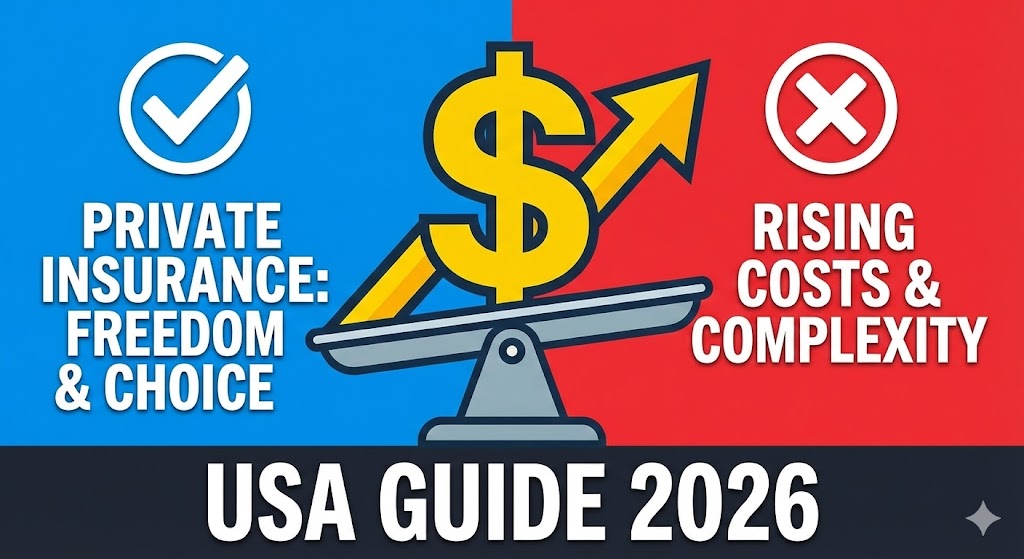
Navigating the American healthcare system can feel like trying to solve a Rubik’s cube blindfolded. With premiums rising and policies changing annually, finding the right coverage is one of the most critical financial decisions a US household will make in 2026.
If you are one of the millions of Americans who doesn’t receive health benefits through an employer—or if you are simply unsatisfied with your current job-based coverage—you are likely looking at private health insurance plans.
Private health insurance offers freedom. It gives you the power to choose your doctors, your hospitals, and your deductible. However, that freedom often comes with a higher price tag. In 2026, the average cost of private health insurance is projected to rise by nearly 20% due to medical inflation and market shifts.
This comprehensive guide breaks down the real pros and cons of private health insurance, analyzes the costs for 2026, and provides actionable advice on finding the best plan for your budget.
What Is Private Health Insurance?
In the United States, “private health insurance” refers to any health coverage plan that is not funded by the government (like Medicare, Medicaid, or TRICARE).
Broadly speaking, private plans fall into two categories:
- On-Exchange Plans (ACA/Marketplace): These are private plans sold through the government-run website HealthCare.gov. They must comply with the Affordable Care Act (ACA), meaning they cover pre-existing conditions and essential health benefits.
- Off-Exchange Plans (Direct-to-Consumer): These are sold directly by insurance companies or brokers. While many are ACA-compliant, some are not (like short-term or fixed-indemnity plans). Off-exchange plans give you more options but fewer federal protections.
The Pros of Private Health Insurance Plans
Why do millions of Americans opt for private plans over government alternatives or employer-sponsored “one-size-fits-all” options?
1. Broader Network Access (PPO Dominance)
One of the biggest advantages of private insurance is the ability to buy a Preferred Provider Organization (PPO) plan. Unlike Medicaid or strict HMOs (Health Maintenance Organizations), PPO plans allow you to see almost any doctor in the country without a referral.
- The Benefit: If you travel frequently or want to see a top specialist in another state, a private PPO plan offers that flexibility.
2. Customization and Control
When you buy your own policy, you are the boss. You don’t have to accept the high-deductible plan your employer chose to save money. You can tailor the policy to your life:
- Young and healthy? You might choose a high-deductible Bronze plan with an HSA (Health Savings Account) to save on taxes.
- Planning a family? You can select a Gold or Platinum plan with lower copays and better maternity coverage.
3. Faster Access to Care
While emergency care is prioritized everywhere, private insurance networks often have shorter wait times for elective surgeries and specialist consultations compared to Medicaid or narrow-network public plans.
The Cons of Private Health Insurance Plans
It is not all positive. The private market is notoriously expensive and complex.
1. The Cost (Premium Inflation)
The elephant in the room is the price. Without an employer subsidizing 70-80% of the premium, you pay the full sticker price.
- In 2026, experts predict the average unsubsidized premium for a 40-year-old on a Silver plan will hover around $752 per month.
- Hidden Costs: Beyond the premium, you must budget for deductibles, which can exceed $7,000 for families on cheaper plans.
2. Complexity of “Metal” Tiers
Private plans use a confusing metal tier system (Bronze, Silver, Gold, Platinum) to indicate how costs are split.
- Bronze: Lower monthly payments, but you pay ~40% of medical costs.
- Platinum: Higher monthly payments, but you pay only ~10% of medical costs.Choosing the wrong tier can cost you thousands if you have an unexpected accident.
3. The “Junk Insurance” Trap
If you shop “off-exchange,” you must be careful. Some plans, known as Short-Term Limited Duration Insurance (STLDI), look like cheap private insurance but are filled with loopholes. They may deny claims for pre-existing conditions or refuse to pay for prescriptions.
Private Health Insurance Costs in 2026
How much will you actually pay? Rates depend heavily on your age, location, and tobacco use.
Average Monthly Premiums by Age (2026 Projections)
| Age Group | Bronze Plan (Avg) | Silver Plan (Avg) | Gold Plan (Avg) |
| Age 21 | $462 | $580 | $650 |
| Age 30 | $525 | $660 | $730 |
| Age 40 | $595 | $752 | $825 |
| Age 50 | $830 | $1,050 | $1,160 |
| Age 60 | $1,260 | $1,590 | $1,750 |
Note: These are unsubsidized averages. If you qualify for ACA tax credits, your actual cost could be significantly lower.
Factors Driving 2026 Cost Increases
- Medical Inflation: Hospitals are charging more for services due to labor shortages.
- GLP-1 Drugs: The high cost of weight-loss drugs like Ozempic and Wegovy is driving up premiums across the board.
- Utilization: As the population ages, people are using more healthcare services, forcing insurers to raise rates.
Best Private Health Insurance Companies (2026 Reviews)
Not all carriers are created equal. Based on network size, customer satisfaction (J.D. Power scores), and financial stability, here are the top contenders for 2026.
1. Blue Cross Blue Shield (BCBS)
- Best For: Nationwide Coverage.
- Why: BCBS is a federation of locally operated companies. Their network is massive—nearly 90% of US doctors and hospitals accept Blue Cross. It is the gold standard for PPO plans.
2. UnitedHealthcare (UHC)
- Best For: Tech-Savvy Users & HSA Plans.
- Why: UHC invests heavily in digital tools. Their app allows you to schedule virtual visits, check claims, and manage HSAs easily. They also offer robust wellness rewards.
3. Kaiser Permanente
- Best For: Integrated Care (HMO).
- Why: Available in states like California, Colorado, and Georgia, Kaiser is unique because they are both the insurer and the hospital system. This “all-in-one” model results in high customer satisfaction and coordinated care, though you are restricted to their facilities.
4. Oscar Health
- Best For: Young Professionals & Freelancers.
- Why: Oscar offers a user-friendly, app-based experience with a dedicated “Concierge” team for every member. They are great for people who want a modern, headache-free interface, though their networks can be smaller.
Types of Private Health Plans Explained
When you get a health insurance quote, you will see acronyms like HMO, PPO, EPO, and POS. Understanding these is vital to avoid unexpected bills.
HMO (Health Maintenance Organization)
- How it works: You must choose a Primary Care Physician (PCP). You need a referral from your PCP to see a specialist.
- Pros: Lowest premiums.
- Cons: No coverage for out-of-network care (except emergencies).
PPO (Preferred Provider Organization)
- How it works: You can see any doctor you want. Staying in-network is cheaper, but out-of-network is partially covered. No referrals needed.
- Pros: Maximum flexibility.
- Cons: Highest premiums.
EPO (Exclusive Provider Organization)
- How it works: A hybrid. You don’t need referrals (like a PPO), but you have zero coverage out-of-network (like an HMO).
- Pros: Cheaper than PPO, more flexible than HMO.
- Cons: Strict network boundaries.
Short-Term vs. Long-Term Private Insurance
If you missed Open Enrollment, you might encounter Short-Term Health Insurance.
- Long-Term (ACA) Plans: These are “real” insurance. They cover you for the whole year, renew automatically, and cover pre-existing conditions.
- Short-Term Plans: These provide temporary coverage (3 months to 3 years depending on the state).
- Warning: They are not required to cover essential benefits like maternity or mental health. They can deny you coverage if you have diabetes, cancer, or even a past injury. Only use these as a desperate bridge between jobs.
Frequently Asked Questions (FAQ)
1. Is private health insurance better than Obamacare?
“Obamacare” (ACA plans) is private insurance, just regulated by the government. The main difference is that on-exchange ACA plans are eligible for subsidies. Off-exchange private plans are not. If you don’t qualify for subsidies, an off-exchange plan might offer a broader network, but the quality of care is often comparable.
2. How can I lower my private health insurance costs?
- Check for Subsidies: Even if you earn $100k+, you might qualify for tax credits if premiums in your area are high.
- Increase Your Deductible: Raising your deductible from $500 to $2,000 can drop your monthly premium by 20% or more.
- Use an HSA: Contributions to a Health Savings Account are tax-deductible, effectively lowering your healthcare costs.
3. Can I buy private health insurance at any time?
Generally, no. You must buy during Open Enrollment (usually Nov 1 – Jan 15). However, if you have a Qualifying Life Event (marriage, birth, job loss, move), you qualify for a Special Enrollment Period and can buy a plan immediately. Short-term plans can be bought year-round.
4. What happens if I don’t have health insurance in 2026?
At the federal level, the tax penalty for being uninsured was removed. However, some states (like California, Massachusetts, New Jersey, and Rhode Island) still have their own individual mandates and will fine you at tax time if you are uninsured.
Conclusion: Making the Right Choice
Private health insurance in the USA is a tool—it can protect your wealth or drain it, depending on the policy you choose.
In 2026, the smart move is to look beyond the monthly premium. Calculate the Total Cost of Care (Premium + Deductible). If you are healthy, a high-deductible PPO with an HSA might be your financial superpower. If you manage chronic conditions, paying more monthly for a Gold HMO could save you thousands by year’s end.
Don’t rush. Compare at least three health insurance quotes. Check the network to ensure your doctor is included. And most importantly, read the fine print to ensure your “private plan” provides the public protection you deserve.